
Culture and Society
From Participation to Public Decision-Making: Amsterdam’s Approach to Citizen Engagement
by Viola Davini and Matilde Mariella Agostini | 30 10 2026
What is this article about?
How can citizen participation become an integral part of public administration and contribute to more inclusive and transparent decision-making? This interview with Simone de Jonge, Participation Advisor Citywide Participation Team Municipality of Amsterdam, Netherlands, explores Amsterdam’s approach to citizen engagement, focusing on the institutional framework, participatory methods and organizational practices developed to strengthen the relationship between the municipality and its citizens. Since the introduction of a city-wide participation policy in 2021 and its subsequent translation into an ordinance in 2023, Amsterdam has sought to establish clearer procedures for involving citizens in public projects and policy development. The interview examines key challenges, including communicating the actual influence citizens can have on decisions, identifying the different groups affected by public policies, and combining digital platforms with face-to-face engagement. Particular attention is also given to local networks and community organizations as essential intermediaries between institutions and citizens. The Amsterdam experience highlights the importance of transparency, methodological flexibility and sustained relationships with communities in developing participation processes that go beyond consultation and contribute meaningfully to public decision-making.
Project
A New Communication Pact between Governance and Citizens
A new communication pact between governance and citizens is a research-action project by the sAu Research Centre exploring how communication can strengthen relationships between institutions, territories and communities. Drawing on experiences such as Viareggio Futura, the project investigates how continuous listening, dialogue and collaborative planning can transform citizen participation from an occasional initiative into an integral part of public governance. It also examines how digital technologies and artificial intelligence can support these processes while keeping human relationships and trust at their core.
This interview is a condensed version of a longer conversation, collected and preserved for research purposes. The selection of excerpts and any edits have been made by the editorial team of Quaderni di sAu, with the aim of presenting the main themes and most significant points that emerged during the conversation.
How has citizen participation developed in Amsterdam in recent years, and what institutional framework supports it today?
During the first municipal government, a democratization agenda led to several initiatives aimed at promoting citizen participation, including participatory budgeting, the co-creation of public spaces and experiments with commons. These experiences contributed to the development of a city-wide policy on citizen engagement. In 2021, Amsterdam introduced a policy establishing how citizens should be involved in municipal processes, including urban development projects, street renovations and the development of new policies. In 2023, this policy was translated into an ordinance that establishes the rules the municipality must follow when organizing participation processes. Today, before starting a participation process, the municipality prepares a participation plan and discusses it with the politician responsible for the project. The plan is then published so that citizens can understand the process and their expected role. At the end, the municipality summarizes the contributions received and explains how they will be considered, including why certain proposals may not be adopted. The ordinance therefore translates the municipality’s broader vision of participation into practical procedures and binding rules.
How can public institutions communicate the actual influence citizens have on decision-making and manage their expectations about the outcomes of participation?
Communicating expectations and clarifying the level of influence citizens can have are among the most challenging aspects of organizing participation processes. It is important to explain how citizens’ contributions relate to the broader decision-making process, including what they can influence and what remains outside the scope of their participation. Since the introduction of the municipal ordinance, we have also conducted evaluations. These have shown that, even when participation plans clearly explain the role of citizens — whether they are providing advice, responding to proposals or exercising decision-making power — participants may interpret their influence differently from what was intended. The evaluations have also indicated that reading the participation plan reduces the likelihood of a mismatch between citizens’ expectations and the actual level of influence available. Nevertheless, this discrepancy remains a challenge that we are continuing to address.
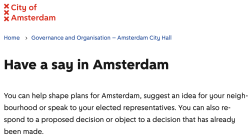
Have a Say in Amsterdam is the City of Amsterdam’s official citizen participation initiative, enabling residents to contribute ideas, share their views on neighbourhood and city plans, respond to proposed policies and engage with elected representatives.
How do you identify the people and groups who should be involved in a participation process, including those who use the city without necessarily living there?
We generally focus on residents, but we also encourage our colleagues to consider who might be affected by a particular project or process. For example, if a project concerns tourism or Amsterdam’s city centre, tourists may also be an important group to involve. Our approach is to collect as little personal information as possible about participants. Rather than systematically asking people where they live or which social group they belong to, we encourage colleagues to consider the different perspectives that should be represented. In a project involving the redevelopment of a public square, for instance, relevant stakeholders may include residents, homeless people who spend time there, people who shop nearby and regular visitors. The objective is to gather as many different perspectives as possible, understand their needs and identify areas of agreement. Differences may also reveal difficult choices that need to be made. Ultimately, the decision about how these perspectives are weighed remains a political one, depending on the level of influence established for the process.
The platform also allows organisations to create and manage both online and in-person meetings, publish documentation, organise consultations and monitor the implementation of projects over time. A cooperative’s general assembly provides a good example. The organisation can use Decidim to convene participants, publish the agenda and supporting documents, collect proposals before the meeting, organise online or face-to-face discussions, and later upload the minutes and final decisions. Participatory budgeting is another well-known application, but the platform is designed to support many different forms of collective decision-making.
Building Democracy Through Technology: How Decidim is Reinventing Citizen Participation
Key Insights from an Interview with Elsa Boloix, Head of Communications at Decidim
by Viola Davini
How do you choose the most appropriate participation methods for different groups of citizens, and how can digital tools be combined with face-to-face engagement to make participation more accessible?
There are many digital tools and different types of participation software available, and we encourage colleagues to explore the options that best suit their projects. One of the main considerations is choosing methods that are appropriate for the groups involved. For example, if we are working with young people, a meeting at the town hall may not necessarily be the most effective approach. We therefore consider who is affected, where these people can be reached and whether a meeting is the best way to engage them or whether other methods might work better. Digital tools can make participation more accessible because people do not necessarily have to attend a meeting at a specific place and time. However, some groups may feel less comfortable participating online or may not have access to the necessary technology. Digital participation should therefore be considered one of several possible methods, rather than the only approach. The municipality currently uses open-source software called OpenStad, which is also used by several other municipalities in the Netherlands. We have also been experimenting with citizens’ lotteries, through which participants are selected randomly. This approach can be used to establish citizens’ assemblies or smaller panels, but it can also be applied to more limited participation processes. The choice of methods also depends on the scale of the project and the groups that need to be involved. For city-wide projects or programmes, we often combine online consultations with more targeted activities. Online questionnaires and platforms can reach a large number of people, while other methods are needed to engage groups who may be less likely to respond to conventional invitations from the municipality. For example, street interviews can be organized in different neighbourhoods, particularly in areas where residents may be less responsive to invitations from the city. Local meetings can also be arranged with specific stakeholders when their perspectives are particularly relevant to the issue being addressed. It is important to recognize that no single participation process will capture everyone’s perspective. Our aim is to hear as many different viewpoints as possible and understand what matters to people. We therefore generally combine broad participation opportunities, open to a wide audience, with smaller and more targeted meetings or activities.
Beyond individual participation processes, how can local networks and community organizations help strengthen the relationship between public institutions and citizens?
Local networks can help connect community organizations, citizens and public institutions, making it easier to share experiences, identify common interests and maintain contact over time. By working together, organizations can also develop a stronger collective voice and communicate the needs of the communities they represent. These networks can be particularly important when public institutions need to engage with groups whose experiences might otherwise remain less visible. For example, cooperation with organizations and services working with children, parents and young people can help the municipality remain in contact with people who have direct experience of youth care. Platforms that bring these groups together provide opportunities to exchange perspectives and maintain an ongoing dialogue with the city. This kind of relationship goes beyond consulting citizens on a single project. It creates channels through which institutions can continue listening to communities, while community organizations can communicate emerging needs and concerns. Maintaining these connections requires ongoing attention and a willingness to engage with citizens beyond the moments when a specific decision has to be made.
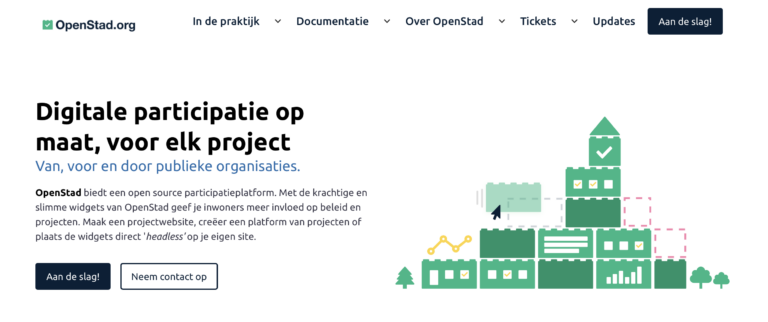
OpenStad is an open-source digital participation platform that enables citizens to contribute ideas, share opinions and participate in local decision-making processes, helping municipalities make public participation more accessible and inclusive: https://openstad.org/
Conclusion
The experience of Amsterdam, like those of Bologna, Barcelona, Milan and Nantes explored in our other interviews, highlights the importance of embedding citizen participation within the institutional framework of public administration. Despite their different contexts and approaches, these cities share a common challenge: building lasting relationships between institutions and communities through transparent processes, inclusive dialogue and meaningful opportunities for citizens to influence public decisions. Amsterdam’s experience shows how clear rules, well-defined participation plans and transparent communication can help establish trust and clarify the role of citizens in decision-making. At the same time, it underlines the importance of combining digital tools with face-to-face activities and strengthening relationships with local communities. Together, these experiences invite us to reflect on how participation can move beyond isolated consultations to become a continuous practice of democratic governance, fostering more collaborative and responsive relationships between institutions and the people they serve.
Authors
Viola Davini
Matilde Mariella Agostini
A student in the Master’s Degree Programme in Communication Practices, Languages and Cultures and the postgraduate programme in Advertising, Communication and Event Management at the University of Florence. She also collaborates with the sAu Research Center.
Simone de Jonge
Participation Advisor, Municipal Participation Team
City of Amsterdam