
Culture and Society
Key Insights from an Interview with Elsa Boloix, Head of Communications at Decidim
by Viola Davini | 30 09 2026
What is this article about?
This article is based on an interview with Elsa Boloix, Head of Communications at Decidim, conducted as part of the sAu Research Center project “A New Communication Pact between Governance and Citizens.”
As governments around the world explore new ways to involve citizens in public decision-making, digital participation platforms are becoming an increasingly important part of democratic innovation. The interview focuses on Decidim, the open-source platform originally developed by the City of Barcelona and now adopted by public institutions, organisations and cooperatives worldwide.
Through the conversation, the article explores the platform’s origins, its democratic philosophy and the global community that has grown around it. Beyond its technical features, Decidim is presented as a broader model of digital democracy, combining open-source technology, participatory governance and civic engagement to strengthen the relationship between institutions and citizens.
Decidim is a free and open-source digital platform for participatory democracy and citizen engagement. It allows institutions and organisations to manage consultations, proposals, participatory processes and collaborative decision-making, combining online participation with in-person activities.
The interview was conducted with Elsa Boloix, Head of Communications at Decidim.
Decidim has become one of the best-known platforms for digital participation worldwide. How did the project begin?
Decidim is a free and open-source digital platform designed to support citizen participation. Because its source code is openly available, any organisation can install, customise and adapt it to its own needs, provided it has the necessary technical expertise, particularly in Ruby on Rails.
The project was launched in Barcelona in 2017 during the administration of Mayor Ada Colau, whose political experience was closely connected to the 15M movement. That movement emerged around demands for greater social justice, democratic participation and digital rights, at a time of intense political debate in Spain.
From the very beginning, Decidim was conceived as more than a technological solution. We see it as part of a broader vision of technopolitics: the idea that digital technologies can strengthen democratic institutions instead of weakening them.
Today, much of our digital life takes place on private platforms whose primary interests revolve around data extraction and commercial objectives. Decidim was created as an alternative model, demonstrating that digital technologies can also serve the public interest by supporting participation, transparency and democratic decision-making.
Today Decidim is used far beyond Barcelona. How widespread has the project become?
Over the years, Decidim has evolved into a truly global ecosystem. The platform is currently used by governments, public administrations, cooperatives, non-governmental organisations and many other institutions around the world.
Today there are more than five hundred active Decidim instances internationally. Most are located in Europe, but the platform has also been adopted across Latin America, Japan and several other regions.
Some of the most significant examples include the City of New York, which uses Decidim for participatory budgeting; the Brazilian federal government, which built its national participation platform on Decidim; and the European Commission, which adopted the platform for the Conference on the Future of Europe. In Italy, one of the most recent implementations is Parma Partecipa.
The diversity of these experiences demonstrates that Decidim is flexible enough to support participation at very different institutional scales, from local governments to supranational organisations.
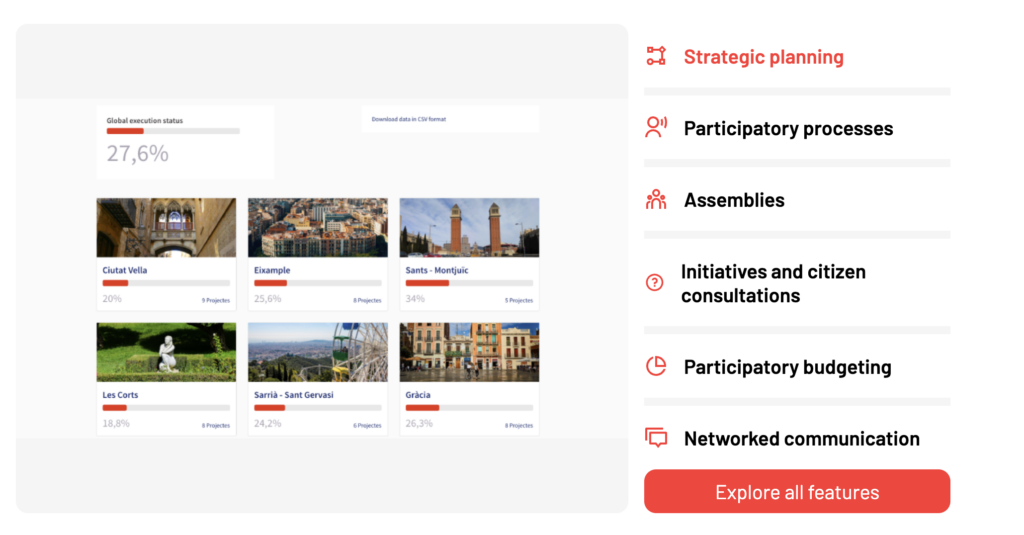
Overview of the main features offered by Decidim, as presented on the official website: https://decidim.org/
What kinds of participatory processes can be developed through the platform?
Decidim enables participants to submit proposals, discuss them, comment on the ideas of others and support initiatives they consider important. In many ways, it functions as a civic participation platform that combines elements of social interaction with structured democratic processes.
The platform also allows organisations to create and manage both online and in-person meetings, publish documentation, organise consultations and monitor the implementation of projects over time.
A cooperative’s general assembly provides a good example. The organisation can use Decidim to convene participants, publish the agenda and supporting documents, collect proposals before the meeting, organise online or face-to-face discussions, and later upload the minutes and final decisions. Participatory budgeting is another well-known application, but the platform is designed to support many different forms of collective decision-making.
Decidim is often described as more than just software. What distinguishes it from other participation platforms?
Decidim combines three interconnected dimensions.
The first is political, represented by the original experience of Decidim Barcelona. The second is technical: the platform is entirely open source and freely available. The third is what we call the technopolitical dimension, embodied by Meta-Decidim, the community where the project itself is collectively discussed and governed.
Our participation model is intentionally open, modular and adaptable. Institutions can customise both the structure and the design of the platform according to their own needs while preserving the democratic principles embedded in its architecture.
The source code is publicly available, and Decidim is recognised as a Digital Public Good. We see it as part of a broader effort to develop digital public infrastructure that serves democratic rather than commercial purposes.
Governance is equally important. The platform is managed by the Decidim Association through committees and working groups that actively contribute to its development. Transparency, accountability and democratic participation are not simply aspirations; they are embedded in the project’s social contract and guide the way the community operates.
Another distinctive feature is that anyone can contribute to improving the platform. Through Meta-Decidim, developers from around the world can report issues, propose new functionalities and collaborate directly on the code, creating a genuinely global open-source community.
Project
A New Communication Pact between Governance and Citizens
The sAu Research Center explores participatory democracy and communication models that strengthen relationships between institutions, territories and communities.
Building on the experience of Viareggio Futura, the project investigates how participation can become an ongoing practice of listening, dialogue and co-design, embedded in governance processes and grounded in the knowledge, needs and expertise of local communities.
You mentioned Meta-Decidim as one of the project’s defining features. What role does it play?
Meta-Decidim is the community where the platform itself is collectively designed, discussed and improved. It is an open governance space that anyone can join by creating a free account.
Users can propose new features, discuss ideas for future developments and contribute to decisions about the evolution of the platform. It is also the space where the Decidim Association carries out much of its governance work. Community members can join thematic working groups dedicated to areas such as software development, design, participation or community activities, and they may also stand for election to the Association’s coordination bodies.
In this sense, Meta-Decidim reflects the same democratic principles that the platform promotes for public institutions. The community does not simply use Decidim—it actively participates in shaping its future.
Metadecidim is the participatory community that democratically governs and improves the Decidim project, bringing together people and organisations that use the platform and contribute to its development: https://meta.decidim.org/en
How is the project governed?
The Decidim Association is responsible for the long-term governance of the project. In 2017, the City of Barcelona entrusted the Association with the maintenance and development of the platform’s source code.
This governance model is quite distinctive because it combines public institutions with an independent open-source community. Rather than treating the software as a proprietary product, the city chose to establish a collaborative model in which public authorities and civic actors jointly contribute to its evolution.
We see this as an example of how open technologies can become part of public policy while remaining transparent, collaborative and community-driven.
Is technical expertise required to adopt Decidim?
Organisations with expertise in Ruby on Rails can install and manage the platform independently. Because Decidim is open source, there are no licensing barriers to adoption.
At the same time, we recognise that many public administrations, cooperatives and organisations do not have the necessary technical capacity. For this reason, the Decidim ecosystem includes a network of official service providers that support institutions throughout the implementation process.
These organisations also contribute to the sustainability of the project by allocating a small percentage of their revenues to the Decidim Association, helping to maintain and further develop the platform.
How is Decidim structured from a technical perspective?
The platform is organised around four main participatory spaces, each designed for a different type of democratic process.
The first consists of Processes, which support structured participation initiatives such as participatory budgeting or strategic planning. Assemblies are intended for permanent or long-term governance bodies, including councils, committees and community groups. Initiatives allow citizens to submit proposals directly, while Conferences are designed to organise events, programmes and discussions.
Each of these spaces can be configured with different participatory components depending on the objectives of the process. Institutions can combine proposals, meetings, surveys, debates, voting systems, accountability mechanisms and many other tools.
We often describe Decidim as being similar to Lego. The platform is modular, allowing organisations to assemble different components and create participation processes that respond to their specific needs.
Barcelona’s participatory budgeting is often presented as one of Decidim’s flagship experiences. Why is it so significant?
The participatory budgeting process launched by the City of Barcelona in 2020 remains one of the most comprehensive examples of what Decidim can support.
For the first time, citizens were invited to decide how to allocate part of the municipal budget within each district. Around €30 million were made available, generating an extraordinary level of participation: nearly 2,000 proposals were submitted, around 400 meetings were organised—both online and in person—and more than 50,000 new participants joined the process.
One story illustrates particularly well how the process unfolded.
A group of young women from the Poble-sec neighbourhood proposed improving the local cricket field, arguing that although cricket is still considered a minority sport, its popularity had grown considerably within their community. Their proposal entered the public discussion alongside hundreds of others before moving to the voting stage, where it received approximately 2,500 votes, becoming the second most supported project in the Sants-Montjuïc district.
The process did not end with the vote. The project proponents worked directly with municipal staff to refine the proposal, assess its feasibility and estimate implementation costs. Information points were then established throughout the district to keep residents informed, followed by the publication of the final results and the implementation phase.
One of Decidim’s distinctive features is precisely this capacity to accompany projects throughout their entire lifecycle. Participants are not only involved in generating ideas but can also monitor how proposals evolve, from submission and deliberation to implementation and completion.
This level of transparency helps strengthen trust in participatory processes and makes public decision-making more visible and accountable.
Digital participation can sometimes exclude those with limited digital skills. How do you address this challenge?
Many of the strategies for inclusion depend on the institutions that adopt the platform, since every territory faces different social and demographic realities. Our role is to provide tools that make participation as accessible and flexible as possible.
One of the principles we consistently promote is hybrid participation. Digital tools should not replace face-to-face engagement but complement it. For this reason, many participatory processes combine online participation with physical meetings and dedicated support services.
Barcelona provides a good example. During participatory budgeting, the city established in-person voting points across different neighbourhoods, where staff could assist residents who were unfamiliar with digital technologies or preferred to participate face to face.
Hybrid participation helps ensure that technological innovation does not become a new source of exclusion. Instead, digital platforms should expand opportunities for participation while preserving accessible offline pathways for everyone.
Artificial intelligence is becoming increasingly present in digital participation. How is Decidim approaching this development?
Artificial intelligence is certainly attracting growing attention, but within Decidim it is approached with the same philosophy that guides the rest of the project. We are currently exploring how to integrate it into various features. Our approach is to remain model-agnostic and, whenever possible, prioritize AI models with open weights, as we believe this aligns most closely with the Social Contract. At the moment, we are waiting for the Mozilla Foundation to confirm funding for a project that includes these developments.
Who typically adopts Decidim, and how is it used over time?
Decidim is generally adopted as a long-term participation infrastructure rather than for a single project.
Public administrations often install the platform at the beginning of a political mandate and continue using it throughout several years for a wide range of participatory initiatives, including participatory budgeting, strategic plans, urban development processes and public consultations.
The platform is also used by cooperatives, associations and other organisations that rely on collaborative decision-making and democratic governance. However, the most established and long-standing experiences continue to come from public institutions, where participation is integrated into everyday administrative practice rather than treated as a one-off initiative.
Conclusion
The experience of Decidim demonstrates that digital participation is not simply a matter of developing new technological tools. It requires rethinking how democratic institutions interact with citizens and how technology can support more transparent, inclusive and accountable forms of governance.
What makes Decidim distinctive is the combination of open-source software, collaborative governance and a global community committed to improving the platform itself. Rather than offering a standardised technological solution, it provides a flexible democratic infrastructure that can be adapted to different institutional, cultural and political contexts.
The examples discussed throughout this interview—from Barcelona’s participatory budgeting to national participation platforms and international collaborations—show how digital technologies can strengthen democratic processes when they are designed around openness, participation and public value.
As governments continue to explore new forms of citizen engagement, Decidim illustrates an alternative vision of digital transformation: one in which technology does not replace democratic participation but helps create the conditions for broader inclusion, greater transparency and more meaningful collaboration between institutions and the communities they serve.
Author
Viola Davini
Elsa Boloix
Elsa Boloix, Head of Communications at Decidim